
News
Industry Updates, Product Insights & Market Information



Send Us A Message
How to assess storage compatibility for inorganic chemicals
How to Assess Storage Compatibility for Inorganic Chemicals
Assessing storage compatibility for inorganic chemicals is not a paperwork exercise completed after purchasing. It is a practical control point between sourcing and safe use. A material can arrive with the correct assay, packaging, and documents, yet still create avoidable risk if it is placed beside an incompatible substance, exposed to unsuitable humidity, or held in a container that gradually degrades.
For quality control and safety managers, the question is rarely just “Can this chemical be stored in the warehouse?” The more useful question is: “Under the actual conditions of this warehouse, in this package, near these other materials, can it remain stable, identifiable, accessible, and safe until use?” That distinction matters for acids, alkalis, oxidizers, metal salts, moisture-sensitive powders, corrosive liquids, and many other classes of inorganic chemicals.
A sound assessment considers the chemical itself, the substances around it, the package, the storage environment, and the route by which the material is received and moved. It should begin before shipment is booked, particularly where international supply involves long transit times, port handling, climate changes, or temporary storage at more than one location.
Start with the hazard profile, not the product name
Trade names and broad categories can be misleading. “Salt,” “mineral,” or “inorganic powder” does not tell a warehouse team enough about reactivity. Two materials with similar-looking names may differ sharply in how they react with water, acids, organic matter, reducing agents, or certain metals. Compatibility decisions should therefore be based on the current Safety Data Sheet (SDS), technical specification, transport classification where applicable, and the actual composition being supplied.
The SDS provides a starting point, especially the information on hazards, stability and reactivity, accidental release measures, handling and storage, and exposure controls. It should not be read as a simple shelf-location instruction. Storage guidance in an SDS often describes general requirements; the site still needs to interpret that guidance against its own inventory, building layout, local rules, emergency systems, and operating practices.
Pay close attention to the following properties:
- Acidic or alkaline character, including the risk of corrosive leakage or neutralization reactions.
- Oxidizing behavior, which can intensify combustion or react dangerously with combustible or reducing materials.
- Water reactivity, hygroscopicity, deliquescence, or decomposition caused by moisture.
- Gas evolution potential, especially when the material contacts acids, water, metals, or incompatible waste residues.
- Corrosivity toward metals, concrete, plastics, seals, pallets, and secondary containment materials.
- Whether the product is a mixture, hydrated grade, coated grade, or solution rather than the nominal pure compound.
This last point is easily missed. Storage compatibility may change when a product grade changes. A different concentration, particle size, moisture level, stabilizer, or packaging configuration can affect caking risk, pressure buildup, container selection, or the seriousness of a spill. Quality teams should ensure that the documentation reviewed matches the product grade and shipment actually received.
Assess incompatibility in layers
A useful review does not rely on one broad rule such as “separate acids from bases.” That rule is necessary, but it is not enough. Inorganic chemicals should be assessed through several layers of compatibility.
Chemical-to-chemical compatibility
The first layer is direct contact. Strong acids and strong bases should generally be separated because accidental mixing can generate substantial heat and splashing. Oxidizers need strict control around combustible materials, organic substances, reducing agents, and materials that may contaminate them during handling. Acids may react with some metals to release hydrogen, while acid contact with certain salts can release toxic or irritating gases. Materials that seem harmless in closed packages can become hazardous after a leak crosses a shared bund, drain, pallet, or cleanup tool.
Do not assume that physical separation alone resolves every issue. Dust migration, shared transfer equipment, open sampling points, and common drainage paths can create contact without one package touching another. For powders, contamination control can be as relevant to storage compatibility as fire or reaction risk.
Chemical-to-package compatibility
The second layer is the relationship between the material and its primary and secondary packaging. A chemical may be stable in one container but unsuitable for another closure, liner, valve, gasket, or overpack. Corrosive liquids can attack metal components. Hygroscopic solids can absorb moisture through compromised closures and form hard lumps, lose flowability, or dissolve into a corrosive liquid. Some materials also require packaging that prevents external contamination rather than merely preventing leakage.
At receipt, inspect more than the outer drum or bag. Confirm container type, closure condition, evidence of wetting, bulging, rust, powder deposits, damaged liners, illegible labels, and pallet stability. A package that has survived transport may still be unsuitable for prolonged storage if its protective layers have been compromised.
Chemical-to-environment compatibility
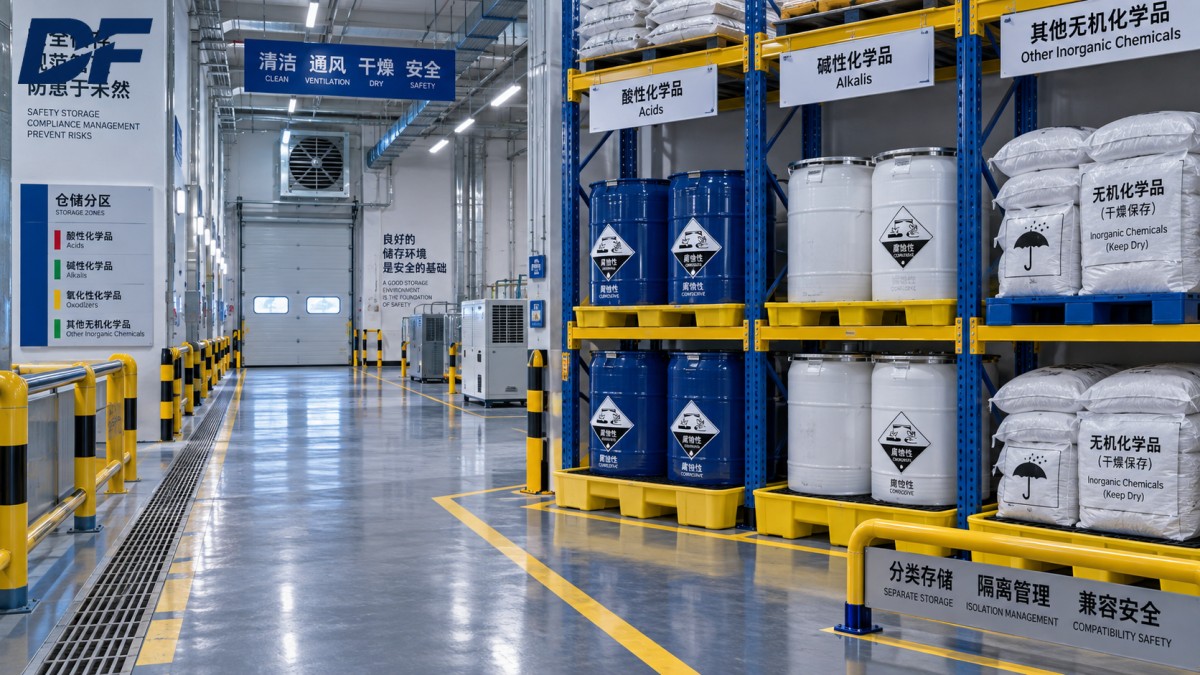
Temperature, humidity, ventilation, sunlight, and floor condition are not background details. They are storage variables. Moisture-sensitive inorganic chemicals may require a dry, protected area and quick resealing after sampling. Aqueous corrosives may need temperature control where freezing or excessive heat can affect package integrity or product concentration. Materials that produce dust require a housekeeping approach that prevents accumulation and cross-contamination. Where incompatible chemicals are stored in the same room, the adequacy of ventilation, spill containment, and drainage isolation should be reviewed together.
Seasonal and transit conditions deserve attention in global supply chains. A shipment may leave a dry production site, pass through humid port conditions, and arrive at a warehouse with a very different climate. For a moisture-sensitive powder, an export-ready package is not automatically a storage-ready package after extended inland warehousing. The receiving plan should account for this transition.
Build a practical segregation decision
A compatibility review should end in a clear operational decision, not a vague note that the material needs “careful storage.” The warehouse team needs to know whether the product can share a zone, requires a separate cabinet or room, needs a dedicated spill tray, must remain away from drains, or should be quarantined pending document review.
Segregation should be proportional to the credible risk. Placing every chemical in a separate area may be impractical and can introduce handling complexity. On the other hand, grouping materials merely because they are all “industrial chemicals” is not a defensible approach. The objective is controlled separation: enough distance, containment, and procedural discipline to prevent contact under normal operations and foreseeable spill conditions.
Use receiving inspection as a compatibility checkpoint
Compatibility is often assessed during initial approval, then forgotten when the shipment arrives. Receiving inspection is the point where assumptions meet reality. The incoming team should compare labels, batch or lot references, quantity, packaging format, and documents against the purchase specification. If the incoming material is a different grade, concentration, or package type from the approved record, the storage decision may need to be reopened.
Quarantine is particularly valuable when there is evidence of leakage, damaged packaging, missing labels, incomplete SDS information, or uncertainty about the product identity. Moving a questionable drum or bag directly into a general stock location can turn a manageable receiving issue into a warehouse incident. A designated, suitably controlled hold area gives quality and safety personnel time to assess the material without disrupting unrelated stock.
Documentation should travel with the decision. Record the approved storage zone, segregation requirements, environmental limits, inspection status, and any restrictions on repacking or sampling. This is more useful than leaving critical knowledge with one experienced operator. It also makes changes easier to manage when shifts change, new warehouse staff join, or products are sourced from a new production partner.
Common mistakes that create avoidable risk
One recurring mistake is treating hazardous-goods transport classification as the complete storage assessment. Transport rules and warehouse storage controls overlap, but they answer different questions. A material may be properly prepared for shipment and still require additional site-specific segregation, containment, or climate protection after arrival.
Another is relying on visual appearance. White powders often get grouped together; clear liquids may be placed in the same corrosive cabinet without checking whether their spill consequences differ. Compatibility must follow hazard and reactivity information, not color, physical form, or familiarity.
Reusing containers is another area where controls can fail. Even a container that appears empty can retain residues. Unless cleaning, material compatibility, labeling, and reuse practices are formally controlled, a previously used package should not be assumed suitable for another inorganic chemical. The same caution applies to scoops, funnels, hoses, pumps, and spill-response tools.
Finally, avoid separating materials on paper while allowing incompatible workflows in practice. If acids and bases are stored apart but use the same uncleaned transfer cart, sampling bench, or drain path, the separation is incomplete.
Connect sourcing decisions with warehouse controls
For internationally sourced inorganic chemicals, storage compatibility should be discussed before the order is finalized. The purchaser may need to confirm whether the available packaging is appropriate for local storage duration, whether palletization supports safe handling, what documentation accompanies the shipment, and whether the product specification is consistent across supply batches. These details affect both quality preservation and safe warehousing.
A supplier that coordinates product selection, quality verification, packaging, and shipment can help make those questions visible early. For example, confirming the intended package type and providing complete product documentation gives the receiving site a better basis for assigning storage locations and preparing inspection procedures. Flexible export arrangements are useful only when the destination warehouse can safely receive and control the material in the form delivered.
Before approving a new material or supplier, bring procurement, quality, warehouse, and safety functions into the same review. Confirm the chemical identity, grade, packaging, expected transit conditions, SDS revision, local requirements, and intended holding period. Where the chemistry or operating conditions are uncertain, obtain competent technical advice rather than relying on a generic compatibility chart.
The strongest storage programs are not built around a single label or checklist. They create a traceable link between chemical hazards, package condition, warehouse design, handling practices, and the actual material received. That link is what protects product quality while reducing the chance that a routine delivery becomes a safety problem.