
News
Industry Updates, Product Insights & Market Information


Send Us A Message
How silicon metal purity influences downstream alloy performance
Silicon metal purity influences downstream alloy performance less through the headline silicon percentage than through the identity, concentration, and variability of the elements contained in the balance. Two lots with similar total Si content can behave differently in melting, chemistry control, solidification, machining, corrosion exposure, and recycled-metal compatibility. For alloy production, the relevant question is therefore not simply “how pure is the silicon metal?” but “which impurities enter the melt, at what recovery rate, and can their contribution be accommodated within the final alloy specification?”
Iron, aluminum, and calcium are the impurity elements most commonly used to classify commercial Silicon Metal, but their significance changes with the alloy system. Iron may be acceptable or even useful in certain aluminum casting alloys, yet problematic in wrought aluminum grades with tight Fe limits. Aluminum can be a manageable contributor in Al-Si foundry alloys but may distort chemistry control where silicon is added to a narrow-composition melt. Calcium can affect slag behavior, inclusion control, and downstream processing even when its direct concentration appears modest.
Purity is a composition-control issue, not a single-number property
Commercial Silicon Metal is commonly specified by silicon content together with maximum limits for Fe, Al, and Ca. Grade descriptions such as 553 or 441 are widely recognized in trade, but they should not be treated as universal technical standards. The interpretation of these designations can vary by producer, region, contract, particle-size form, and analytical basis. A grade label is useful for initial screening; it is not a substitute for a complete certificate of analysis and an agreed purchase specification.
For an alloy producer, impurity loading is calculated from the silicon addition rate. If a melt requires a substantial silicon addition, even a small change in impurity concentration can become material in the final composition. The basic mass-balance relationship is straightforward:
Impurity added to melt = Silicon Metal addition × impurity concentration × effective recovery factor.
The recovery factor is not necessarily identical for silicon, iron, aluminum, calcium, or other trace constituents. Some elements may report almost completely to the liquid metal, while others can partition partly into oxide films, slag, dross, or furnace residues depending on charge practice and furnace conditions. A specification review that assumes every reported impurity behaves identically can give misleading results.
Purity also has a statistical dimension. A supplier may provide material whose average analysis meets a stated maximum, while individual lots sit close to the upper limit. For a downstream alloy with little chemistry margin, lot-to-lot variation is more consequential than the nominal grade name. The practical requirement is often a controlled maximum and a credible distribution of results, rather than a favorable average value.
Iron: often the most consequential impurity in aluminum alloy production
Iron is generally the dominant impurity concern when Silicon Metal is used in aluminum alloys. Its effect depends strongly on the alloy family, solidification rate, manganese level, and intended product form.
In Al-Si casting alloys, iron can form iron-rich intermetallic phases during solidification. Their morphology matters. Plate-like or needle-like iron-bearing phases may act as stress concentrators and reduce ductility, impact resistance, pressure tightness, or fatigue performance. Under certain chemistry conditions, manganese additions can modify iron-bearing phase formation toward less harmful morphologies. That does not eliminate the need to control iron; it changes the allowable chemistry window.
Where castings are intended for high elongation, demanding fatigue duty, leak-sensitive components, or thin-wall sections, the available Fe margin may be narrow. Silicon Metal with a higher Fe level can force compensating adjustments elsewhere in the charge. These adjustments may involve using lower-iron return material, changing primary aluminum selection, increasing manganese control, or accepting a lower operational margin. The cost and technical complexity are not visible from the Silicon Metal purchase price alone.
For wrought aluminum products, iron is frequently more restrictive. Iron-containing intermetallic particles can affect formability, surface quality, conductivity, and fracture behavior. The acceptable impurity contribution from Silicon Metal must be considered alongside all other charge materials, including scrap, master alloys, remelt ingot, and alloying additions. A silicon source that is suitable for a casting operation may be unsuitable for a tightly controlled wrought composition.
Iron also affects furnace practice indirectly. When a melt approaches its iron limit, operators have limited corrective options because iron is not readily removed through ordinary melt treatment. Avoiding excess iron at the raw-material stage is generally more reliable than trying to correct the chemistry after melting.
Aluminum and calcium affect more than the certificate value
Aluminum contained in Silicon Metal is not inherently detrimental when the downstream alloy already contains aluminum as its base metal. Its importance lies in accounting. In an Al-Si alloy, the aluminum contribution from Silicon Metal is small relative to the total aluminum bath, but it is still relevant when silicon additions are large or when alloy chemistry is controlled close to lower or upper limits.
Aluminum becomes more significant when Silicon Metal is used outside a predominantly aluminum-based melt, or where silicon is introduced into a multicomponent alloy with strict element balances. It can alter the calculated addition required to reach target silicon, particularly if batch calculations assume a fixed silicon recovery based only on nominal purity.
Calcium deserves particular attention because it is sometimes treated as a secondary impurity simply because its reported percentage is lower than Fe or Al. In melting operations, calcium can have disproportionate effects on oxide and slag behavior. Its high chemical reactivity means its route through the process can differ from that of iron. Depending on furnace atmosphere, fluxing practice, melt temperature, and holding time, calcium may contribute to non-metallic reaction products rather than appearing entirely in final bulk-metal analysis.
That does not make calcium irrelevant to alloy chemistry. It means that calcium must be evaluated in relation to process conditions. In some applications, elevated Ca can increase the uncertainty of dross formation, melt cleanliness, or inclusion management. In others, the more immediate concern is whether the supplier’s calcium control is stable enough to prevent changes in furnace behavior between consignments.
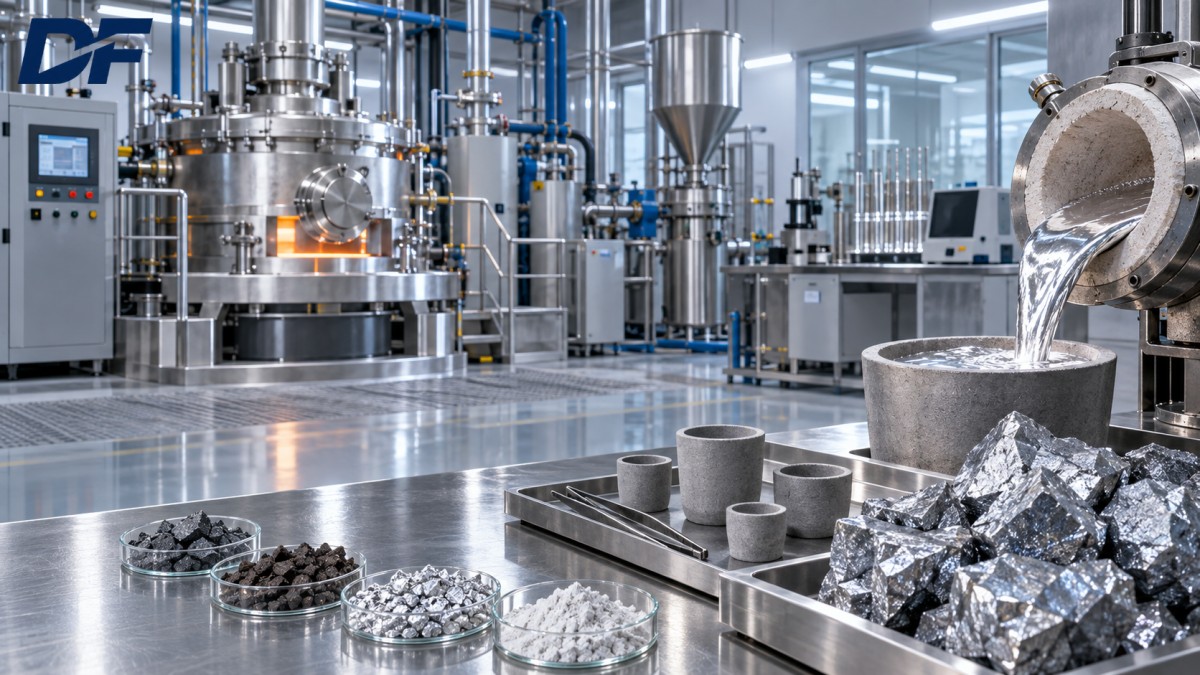
The alloy system determines what “high purity” actually means
A higher Si percentage is not automatically the better technical choice. The appropriate Silicon Metal grade is the one whose impurity profile fits the downstream composition and process route with sufficient margin.
In ferrous applications, Silicon Metal may be selected for silicon addition where a cleaner input is needed than certain alternative ferroalloys can provide. Yet the acceptable impurity profile remains application-specific. Residual aluminum, calcium, phosphorus, sulfur, titanium, chromium, or other elements can matter depending on the steel or alloy chemistry. The correct comparison is not “Silicon Metal versus another silicon source” in the abstract, but the delivered element package, recovery behavior, and effect on the furnace charge.
For high-cleanliness alloys, trace constituents may matter as much as Fe-Al-Ca. Boron and phosphorus can be critical in semiconductor-related silicon applications, but their relevance to metal alloying differs. Titanium, chromium, vanadium, carbon, oxygen-bearing inclusions, and metallic contaminants may require attention in selected alloy systems. A routine commercial analysis may not report every element needed for a sensitive application. The test list should follow the downstream alloy specification and failure mechanism, not merely the conventional Silicon Metal grade convention.
Particle size and physical condition can change effective purity in use
Chemical analysis alone does not fully determine alloying performance. Silicon Metal is supplied in lumps, crushed fractions, granules, fines, or other size ranges. Size distribution influences dissolution rate, oxidation exposure, segregation during handling, and sampling reliability.
Fine material has a larger surface area and can be more susceptible to oxidation and dust generation. In a furnace charge, excessive fines may be lost to fume extraction, become entrained in dross, or dissolve differently from larger pieces. Very large lumps can dissolve more slowly and may create local composition gradients if charge timing and bath circulation are inadequate. The apparent purity of the material can therefore differ from its effective silicon yield in the furnace.
Segregation is another issue. If a shipment contains a broad particle-size distribution, compositional variation can be concentrated in specific fractions. Sampling only from accessible large pieces may not represent the fine fraction, where surface oxidation, contamination, or processing residues can be different. A technically meaningful incoming inspection plan must define how material is sampled across the package and across size fractions.
Surface contamination should also be separated from bulk composition. Moisture, dust, foreign particles, packaging fragments, and cross-contamination from crushing or storage do not necessarily appear in a bulk chemical assay of a selected lump. They can nevertheless affect furnace cleanliness, hydrogen control, dross generation, or melt-treatment demand.
Reading certificates of analysis with the right level of skepticism
A certificate of analysis is necessary, but it should be read as evidence tied to a particular sampling and testing process. Several questions determine whether the certificate is adequate for alloy qualification:
- Does the analysis identify the lot, production date or batch reference, and shipment quantity?
- Are Si, Fe, Al, and Ca reported as actual results or only as conformance statements against limits?
- Which analytical method was used, and is it suitable for the elements under control?
- Was the sample taken from the finished lot after crushing and sizing, rather than from an earlier production stage?
- Are trace elements reported where the final alloy specification requires their control?
- Is the result expressed on a consistent basis, including treatment of oxygen, moisture, or non-metallic material where relevant?
For metallic silicon, methods such as X-ray fluorescence can be useful for routine elemental screening, while wet chemical methods, optical emission spectrometry after suitable sample preparation, and inductively coupled plasma techniques may be used depending on the element and laboratory procedure. No method is automatically sufficient without considering sample representativeness, calibration range, detection limits, and the matrix being analyzed. A highly precise analysis of an unrepresentative sample does not provide reliable lot control.
Disputes over purity often originate in sampling rather than instrumentation. Silicon Metal is heterogeneous at the scale of individual pieces because impurities can be distributed through solidification structures and because crushed material may segregate by size. Contract specifications should therefore define not only maximum chemistry limits but also sampling frequency, sample preparation, retest procedures, and the handling of composite samples.
Specification limits should be linked to alloy chemistry margin
Setting a Silicon Metal specification by copying a familiar commercial grade can create unnecessary cost or hidden performance risk. A more defensible method begins with the final alloy’s maximum allowable residual levels. From there, each charge material is assigned an impurity budget.
Consider iron in an aluminum alloy with a strict upper limit. The allowable Fe contribution from Silicon Metal is not the alloy limit itself. It is the remaining margin after accounting for base aluminum, return scrap, master alloys, grain refiners, modifiers, and expected process variation. If the calculated remaining margin is small, the Silicon Metal requirement should include an internal operating buffer rather than placing the grade maximum exactly at the theoretical limit.
The same approach applies to aluminum and calcium, although their treatment may include process-specific recovery factors. The specification should also distinguish between a contractual maximum and a preferred operating target. A contractual maximum protects against nonconforming material; a lower operating target helps maintain stable melting practice.
Where several Silicon Metal sources are qualified, equivalence should be established through chemistry and process behavior rather than grade name alone. Two suppliers may both offer material described by the same shorthand designation while differing in Fe-Al-Ca balance, particle-size distribution, oxide content, packaging condition, or analytical reporting discipline. Those differences may be immaterial in one alloy but unacceptable in another.
Common errors in purity assessment
The most persistent error is treating total silicon content as a direct predictor of alloy performance. It is only one part of the material balance. A slightly lower silicon content with tightly controlled iron and calcium may be more suitable than a nominally higher-purity material with an unfavorable impurity distribution.
Another error is specifying only Fe, Al, and Ca when the downstream alloy is sensitive to other residual elements. Conventional commercial grading simplifies trade, but final alloy requirements may demand a broader elemental panel. The required analysis should be determined by the consequences of deviation: mechanical-property loss, electrical-conductivity change, corrosion risk, processing instability, or incompatibility with recycling streams.
It is equally risky to ignore the interaction between raw material purity and recycled charge. A process using high and variable scrap content may need tighter Silicon Metal control because the incoming scrap already consumes much of the impurity budget. Conversely, a primary-metal-based process with stable inputs may safely accept a different commercial grade. The appropriate silicon source cannot be selected independently of the full charge mix.
Silicon Metal purity is therefore best understood as a controlled input to an alloy system, not as an isolated commodity attribute. The critical evaluation combines elemental limits, lot consistency, physical form, analytical credibility, furnace recovery, and the remaining chemistry margin of the target alloy. When those factors are aligned, silicon addition becomes predictable. When they are not, a material that appears compliant on paper can become the source of avoidable variation in downstream alloy performance.